








Regency Park Fruit Trees (Popular)
Regency Park Fruit Trees and the most popular plants Australians buy for mail order. With fruit trees you should consider climate suitability.
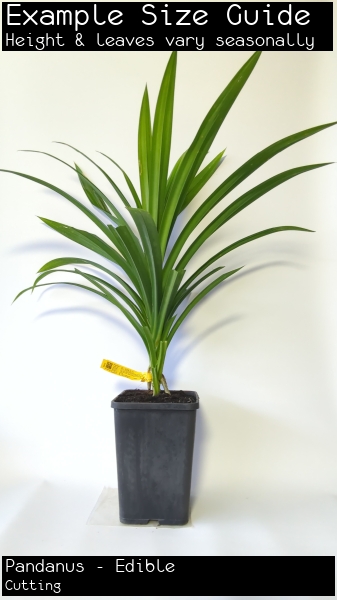
Pandanus - Edible
$40.95 ($24.90-$69.00 choose a size)
Widely cultivated for use in Asian cooking and basket making. It has a nutty fragrance and is most commonly used in rice dishes or tied in a bundle and cooked with food. Also useful in flower arrangements. A low growing plant to 1m with long narrow blade like leaves and woody aerial roots. In tropical climates it can be grown as a marginal plant in dams and ponds, used as a bedding plant in tropical landscaping. Outside of the tropics, well worth trying as indoor plant in winter with a warm, sunny aspect. Allow the plant to dry out over the winter months, but maintain humidity


Lychee - Seedless
$89.00
Sue Lin San Lychee is sweet, large, juicy and predominately seedless, with tropical flavours of pineapple. This unique and desirable fruit can now be grown at home.

Dwarf Mango - King Thai
$99.00 ($79.00-$99.00 choose a size)
A semi-dwarf tree making it ideal for backyards, it produces elongated fruits with a very small seed. Flesh is sweet, succulent, fibreless and aromatic with a slight tang. The fruits start out with green skin and ripen to yellow with pink-red blushed fruit. Compact, branching, slightly upright tree growing to 3-4m tall and 2-3m wide. Shows good resistance to anthracnose and black spot. The fruit of a clone of King Thai mango are sold commercially as Maha Bliss in Australian Markets.


Dwarf Mango - Irwin
$89.00 ($89.00-$149.00 choose a size)
Dwarf tree, sweet mild flavour. Regular, moderate yield. Attractive red purple skin colour. Flesh Average wt. 380gms. Low resistance to Anthracnose and Black Spot. Mid season fruiting. Harvested from a specific region of Japan, Irwin varieties are rotated as they ripen to evenly expose the surface to the sun and reach their full purple blush potential, when they are sold as Myazaki Mangos.

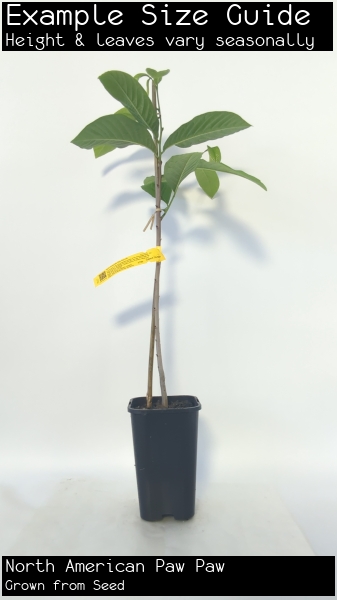
North American Paw Paw
$99.00 ($59.00-$99.00 choose a size)
The pawpaw is the only temperate member of the Annonaceae family. The highly aromatic, climacteric fruit (meaning it can ripen off the tree) has a ripe taste that resembles a creamy mixture of banana, mango, and pineapple It is a small, deciduous tree that may attain 5 to 10 m in height. In the forest understorey, trees often exist in clumps or thickets. This may result from root suckering or seedlings developing from fruits that dropped to the ground from an original seedling tree. In sunny locations, trees typically assume a pyramidal habit, straight trunk and lush, dark green, long, drooping leaves that turn gold and brown in colour during the fall. Flowers emerge before leaves in mid spring. The blossoms occur singly on previous year's wood and may reach up to 5 cm in diameter. Flowers are strongly protogynous, self-incompatible and require cross pollination although some trees may be self-compatible it is a good idea to plant two or more trees for cross pollination. Fruits are typically 3 to 15 cm long, 3 to 10 cm wide and weigh from 200 to 400 g. They may be borne singly or in clusters which resemble the "hands" of a banana plant (Musa spp.). Shelf-life of a tree-ripened fruit stored at room temperature is 2 to 3 days. With refrigeration, fruit can be held up to 3 weeks while maintaining good eating quality. Within the fruit, there are two rows of large, brown, bean shaped, laterally compressed seeds that may be up to 3 cm long.
pin_drop